
FV Methodology
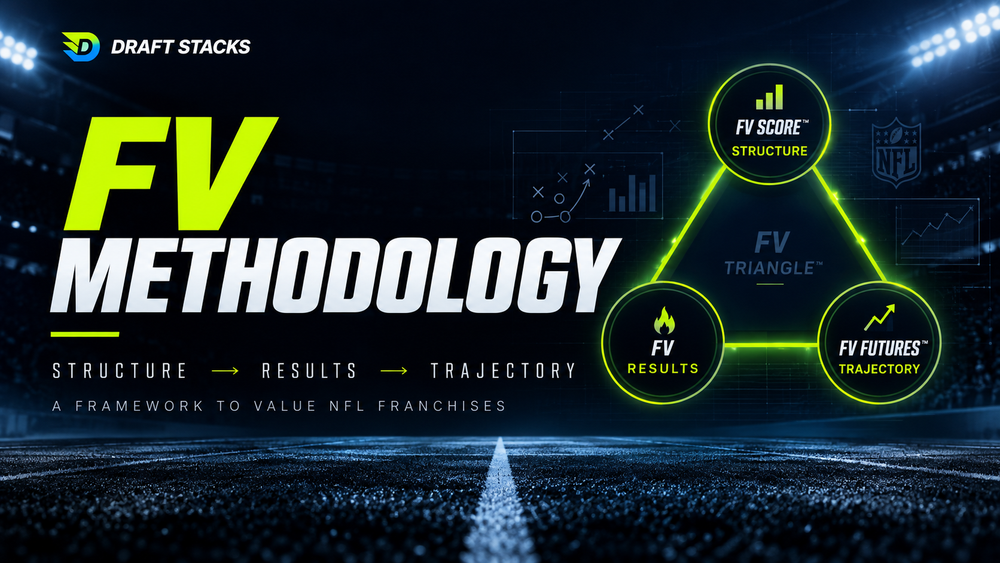
Structure. Results. Trajectory.
September 2026 | Internal methodology with approved external disclosure
“Most rankings begin with what a team has done. FV begins with what the franchise has built.”
1. What FV Is
FV is Draft Stacks’ franchise valuation framework. It is designed to understand the organization behind NFL results, track meaningful evidence those organizations produce during the season, and translate that information into a forward-looking franchise trajectory.
FV is not a power ranking. It does not rewrite its opinion after every Sunday. It separates structural valuation from weekly performance so short-term noise does not masquerade as organizational truth.
One franchise // three windows
| Window | Product | Question | Function |
|---|---|---|---|
| STRUCTURE | FV SCORE™ | What has the franchise built? | 0–100 structural health valuation. |
| RESULTS | FV 🔥 | What meaningful evidence is it producing now? | Internal weekly evidence tracking across eight football areas. |
| TRAJECTORY | FV FUTURES™ | Where is the franchise headed? | Three-year analyst projection informed by structure and evidence. |
2. FV Score™ // Structural Valuation
FV Score measures the current structural health of an NFL franchise. It is a 0–100 valuation created from accumulated organizational decisions, not a weekly performance score. The FV Triangle™ is the 12-layer framework that powers the score.
| Area | Weight | What It Represents |
|---|---|---|
| Roster | 15% | Player talent and roster construction; QB talent lives here. |
| Coaching Staff | 15% | Quality and effectiveness of the coaching operation. |
| Front Office | 15% | Personnel leadership, acquisition and organizational decision-making. |
| Leadership | 11% | Alignment, accountability, decision quality and cross-pillar coherence. |
| Scouting | 9% | Talent identification, draft/UDFA process and evaluation quality. |
| Development | 8% | Ability to improve and maximize players after acquisition. |
| Scheme | 7% | Adaptability, deployment and schematic fit. |
| Analytics | 6% | Use of information, decision support and modern strategic tools. |
| Salary Cap | 5% | Contract efficiency, allocation, flexibility and resource management. |
| Sports Science | 4% | Performance infrastructure, recovery and durability processes. |
| Health | 3% | Structural durability and organizational health environment. |
| QBX | 2% | The environment around the quarterback; QB talent itself is not graded here. |
Foundational Pillars total 45%. Internal Systems total 55%. The weighting intentionally evaluates both visible football leadership/talent and the less visible infrastructure that acquires, develops, deploys, supports and sustains it.
LAYER BOUNDARIES THAT MUST REMAIN CLEAN
• QBX is the apex environment layer only. Quarterback talent belongs in Roster. QBX evaluates the environment constructed around the quarterback.
• Leadership measures cross-organizational coherence, alignment, accountability and decision quality—not a second grade for the owner, GM or head coach.
• Health separates structural durability and organizational health infrastructure from weekly player availability. Current injury movement can appear in FV 🔥.
• Scheme and Coaching Staff are related but not duplicates: one evaluates the football system and adaptability; the other evaluates the people responsible for teaching, coordinating and leading it.
FV Score review cadence
FV monitors continuously but values periodically. Official structural reviews occur at Preseason, Post Week 4, Post Week 9, Post Week 13 and Post Week 18. A review does not guarantee a score change. After Week 18, the score freezes until the next Preseason FV.
3. FV Futures™ // Trajectory
FV Futures translates structural health, the composition of FV Score and analyst judgment into a three-year football outlook. It is informed by FV; it is not mechanically dictated by a single score. Prediction belongs here—not inside the definition of FV Score.
4. FV 🔥 / FV Heatmap // Weekly Results Intelligence
FV 🔥 is Draft Stacks’ internal weekly evidence system.
It tracks meaningful positive and negative football signals between formal FV Score reviews, helping determine which structural assumptions are being confirmed, challenged, or left unchanged. The underlying analyst database is proprietary and is not published in full.
5. THE EVIDENCE MODEL
FV is not proprietary because it possesses secret football statistics. Its differentiation comes from the logic used to interpret evidence, assign it to the correct layer, weight it, and preserve the judgment over time.
THE METRICS AREN’T PROPRIETARY. WHAT FV DOES WITH THEM IS. |
THREE EVIDENCE BUCKETS
• PERFORMANCE DATA — EPA/play, Success Rate, pressure/protection metrics, explosive plays, personnel usage, opponent-adjusted performance, availability and durability data.
• FOOTBALL EVALUATION — Player grades, film evaluation, roster quality, coaching and scheme fit, player development, personnel deployment, organizational decision-making.
• FRANCHISE ECONOMICS — salary-cap allocation, contract value, guarantees and dead money, roster age, draft capital, positional investment and future flexibility.
But collecting information is not the methodology. Deciding what it means is.
6. THE FV LOGIC
FV applies internal logic to determine what matters, how much it matters and where it belongs. This is where football judgment becomes explicit rather than hidden.
CANONICAL EXAMPLES
• Roster = 15% of FV Score. Quarterback = 30% of the Roster grade. The premium reflects both the position’s disproportionate influence on winning and the scale of resources elite quarterback contracts can consume.
• Draft Capital is not simply future picks. It represents access to young talent, contractual efficiency and future roster flexibility.
• Leadership is not reputation. It evaluates alignment, accountability and decision quality across the organization.
• QBX does not grade QB talent. QB talent is already in Roster; QBX evaluates the environment around the position.
• Health distinguishes long-term organizational durability from current availability.
7. FIREWALLS — HOW JUDGMENT IS DISCIPLINED
THE OBJECTIVE ISN’T TO ELIMINATE SUBJECTIVITY. IT’S TO DISCIPLINE IT. |
OUTCOME FIREWALL Wins, losses and box-score production are evidence, not automatic proof of structural quality. Evaluate the systems responsible.
ATTRIBUTION FIREWALL Assign results to the component most responsible. A sack is not automatically protection failure; QB production is not automatically QB success. Context matters.
DOUBLE-COUNTING FIREWALL Separate overlapping information across layers. QB talent vs. QBX and Coaching Staff vs. Scheme are canonical examples.
LEADERSHIP FIREWALL Leadership measures organizational coherence, alignment, accountability and decision quality—not simply the reputation or record of an individual.
DISTRIBUTION FIREWALL Do not force 32 teams into a predetermined curve. The evidence determines the distribution.
REVIEW FIREWALL FV Score is reconsidered only at predetermined checkpoints. FV 🔥 can flag evidence for review but can never automatically change the structural valuation.
INSTITUTIONAL MEMORY
Never silently overwrite the past. Preserve valuation vintages such as FV 63.2 // PRESEASON, FV 64.7 // POST WK 4, etc. PFP26 remains the immutable September 2026 preseason record. Movement belongs to later FV vintages, FV 🔥 and future products.